
Comprendre le GHRP-2 en tant que peptide de recherche
Le GHRP-2 (peptide libérateur de l'hormone de croissance n° 2) est un hexapeptide synthétique largement utilisé dans la recherche en laboratoire pour étudier la signalisation de l'axe somatotrope. Il se lie de manière sélective au récepteur de la ghréline (GHS-R) et peut stimuler la libération de l'hormone de croissance dans des modèles cellulaires in vitro bien contrôlés. Les chercheurs utilisent le GHRP-2 pour étudier les voies intracellulaires, les interactions récepteur-ligand et les mécanismes moléculaires qui régulent la sécrétion hormonale. Lors de l'acquisition de ce peptide, il est essentiel de choisir un fournisseur fiable de GHRP-2 de qualité recherche afin de garantir une qualité constante du produit et d'assurer la reproductibilité des résultats expérimentaux.
Structure chimique et propriétés
Le GHRP-2 présente la séquence d'acides aminés D-Ala-D-β-Nal-Ala-Trp-D-Phe-Lys-NH₂, où D-β-Nal désigne la D-β-naphtylalanine. L’incorporation d’acides aminés D et l’amidation C-terminale lui confèrent une résistance à la dégradation enzymatique rapide, ce qui est avantageux pour une activité prolongée dans le cadre de la recherche. Le peptide est généralement fourni sous forme de poudre stérile et lyophilisée, qui est hygroscopique et doit être conservée en conséquence. Pour une conservation à long terme, une température de –20 °C dans un environnement déshydraté est recommandée ; il convient d’éviter les cycles répétés de congélation-décongélation afin de préserver l’intégrité structurelle. Avant toute utilisation dans des essais cellulaires, les chercheurs reconstituent le GHRP-2 dans un solvant approprié (par exemple, de l’eau stérile pour injection ou un tampon acétate) à une concentration adaptée au protocole spécifique. Il est conseillé de manipuler le produit avec précaution en utilisant des consommables à faible liaison protéique afin de minimiser les pertes par adsorption en surface.
Critères permettant d'identifier un fournisseur fiable de matériel de recherche
Pour les scientifiques qui utilisent le GHRP-2 dans le cadre de protocoles expérimentaux exigeants, le choix d'un fournisseur proposant des produits de qualité recherche a une incidence directe sur la qualité des données. Un fournisseur fiable respecte des procédures rigoureuses de caractérisation analytique et fournit une documentation transparente spécifique à chaque lot. Les critères suivants sont essentiels pour évaluer la fiabilité d'un fournisseur.
- Vérification de la pureté grâce à des techniques d'analyse orthogonales, garantissant généralement une pureté supérieure à 98%.
- Certificat d'analyse complet (CoA) qui présente en détail les résultats propres à chaque lot, y compris les données chromatographiques et spectrométriques.
- Fabrication dans des conditions contrôlées (souvent conformes à des normes de type BPF) afin de garantir la cohérence d'un lot à l'autre.
- Transparence en matière d'approvisionnement, d'étiquetage et de documentation d'exportation qui facilite le dédouanement et la mise en conformité réglementaire.
Contrôle qualité et certificats d'analyse
Chaque lot de production de GHRP-2 est soumis à une série de tests analytiques visant à confirmer son identité et sa pureté. La chromatographie liquide haute performance en phase inverse (HPLC) est utilisée pour quantifier la pureté, généralement avec une détection à 214 nm, tandis que la spectrométrie de masse à ionisation par électrospray (ESI-MS) ou la désorption/ionisation laser assistée par matrice (MALDI-TOF) permettent de vérifier que le poids moléculaire correspond bien à la masse théorique. Le certificat d’analyse (CoA) joint indiquera le temps de rétention, les pics d’ions moléculaires observés et le pourcentage de pureté en surface. Certains fournisseurs proposent également une analyse des acides aminés ou une détermination de la teneur en peptides. Pour renforcer la confiance, des services d’essais indépendants réalisés par des tiers peuvent être proposés sur demande, permettant ainsi aux groupes de recherche de vérifier les résultats analytiques avant de s’engager dans des études à grande échelle.
Conformité en matière d'emballage et d'expédition
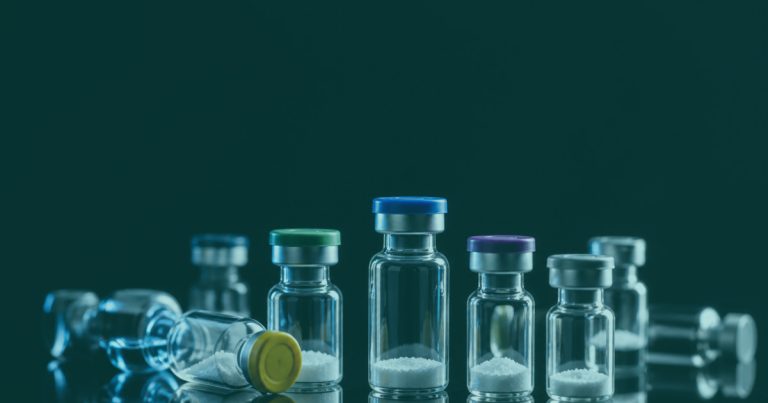
Le GHRP-2 est fourni sous forme de poudre lyophilisée dans des flacons en verre stériles et scellés qui protègent le peptide de l'humidité et de toute contamination microbienne. La forme lyophilisée étant intrinsèquement stable à des températures modérées pendant toute la durée d'un transport classique, le peptide est expédié à température ambiante sans nécessiter de chaîne du froid, sauf indication contraire du destinataire. Chaque envoi comprend un dossier documentaire complet : un certificat d’analyse, une fiche de données de sécurité (FDS) et une facture commerciale. Ces documents aident les instituts de recherche et les autorités douanières à vérifier le contenu et les exigences de manipulation, réduisant ainsi les délais de dédouanement. Les flacons sont étiquetés avec le nom du peptide, la quantité nette, le numéro de lot et les conditions de conservation recommandées, afin d’assurer une traçabilité totale.
Applications du GHRP-2 dans la recherche en laboratoire
Dans l'environnement contrôlé d'un laboratoire de recherche, le GHRP-2 constitue un outil précieux pour analyser le fonctionnement du récepteur de la ghréline et les cascades de signalisation en aval. Son utilisation est limitée à in vitro systèmes et ne s'applique pas à un contexte diagnostique, clinique ou vétérinaire. Ce peptide permet d'étudier de manière reproductible les mécanismes de libération de l'hormone de croissance et la pharmacologie de ses récepteurs, en complément d'autres sécrétagogues.
Culture cellulaire et études in vitro
Les chercheurs utilisent couramment le GHRP-2 dans des cultures de cellules hypophysaires — telles que des cellules hypophysaires antérieures primaires de rat ou des lignées cellulaires somatotrophes établies — afin de stimuler la sécrétion de l'hormone de croissance. Ce peptide active le récepteur de la ghréline de type 1a (GHS-R1a), un récepteur couplé aux protéines G qui s'associe via la sous-unité Gαq/11. La signalisation en aval comprend l’activation de la phospholipase C, la production d’inositol trisphosphate et la mobilisation du calcium intracellulaire. Les chercheurs surveillent également l’accumulation d’AMP cyclique (AMPc) et la phosphorylation de la protéine kinase activée par les mitogènes (MAPK) afin de cartographier l’étendue de la signalisation médiée par les récepteurs. En comparant la réponse au GHRP-2 à celle d’autres agonistes synthétiques tels que l’hexareline ou le GHRP-6, les scientifiques peuvent déterminer les relations structure-activité et caractériser la cinétique de liaison au récepteur dans un environnement contrôlé.
Recherche en endocrinologie
Au niveau cellulaire, le GHRP-2 permet de mieux comprendre comment la libération de l’hormone de croissance est régulée avec précision par des signaux métaboliques. Il est fréquemment utilisé pour étudier l’interaction entre l’activation du récepteur de la ghréline et l’inhibition médiée par la somatostatine dans des modèles de cellules primaires ou dans des lignées cellulaires modifiées surexprimant ce récepteur. Ces expériences permettent de mettre au point des tests in vitro pour la pharmacologie des récepteurs, ce qui permet aux chercheurs de cribler de nouveaux ligands, de mesurer la sélectivité fonctionnelle et de valider des mutants de récepteurs. Les données issues de ces études contribuent à une meilleure compréhension des boucles de rétroaction neuroendocriniennes, dans le seul but de la recherche scientifique fondamentale.
Pourquoi choisir notre peptide GHRP-2 de qualité recherche ?
Pour les laboratoires qui exigent une grande cohérence et une documentation complète, notre peptide GHRP-2 de qualité recherche est conçu pour répondre à des critères de qualité rigoureux. Chaque lot est soumis à un contrôle qualité rigoureux, avec une pureté dépassant systématiquement 98%, comme le confirment les analyses par HPLC et spectrométrie de masse. Le certificat d’analyse spécifique à chaque lot, accompagné d’une fiche de données de sécurité (FDS) et d’une facture détaillée, fournit aux instituts de recherche tous les documents nécessaires aux audits de conformité internes et à un dédouanement sans encombre. Nous proposons aux acheteurs institutionnels des tarifs compétitifs et des remises échelonnées sur les commandes en gros, tandis que notre réseau logistique assure une livraison rapide et traçable vers les principaux pôles de recherche à travers le monde. Une équipe d’assistance client réactive est à votre disposition pour répondre à vos questions techniques concernant la manipulation, le stockage et la documentation, afin de garantir que votre processus d’approvisionnement soit aussi simple que possible.
Questions fréquemment posées
Quels sont les degrés de pureté proposés pour le GHRP-2 ? Nous fournissons du GHRP-2 dont la pureté est supérieure à 98%, comme le confirment les analyses par HPLC et par spectrométrie de masse, et chaque envoi est accompagné d'un certificat d'analyse spécifique au lot.
Comment le GHRP-2 est-il expédié ? Le peptide est fourni sous forme de poudre lyophilisée dans un flacon scellé et expédié à température ambiante. Sa stabilité dans des conditions de transport normales rend le transport sous chaîne du froid inutile dans la plupart des cas.
Fournissez-vous les documents nécessaires au dédouanement ? Oui. Chaque commande est accompagnée d'un certificat d'analyse, d'une fiche de données de sécurité (FDS) et d'une facture commerciale décrivant précisément le contenu à des fins douanières.
Puis-je demander un échantillon à des fins d'évaluation scientifique ? Des échantillons peuvent être mis à disposition des groupes de recherche éligibles. Veuillez contacter notre équipe d'assistance en indiquant les coordonnées de votre établissement afin de discuter des conditions et de la disponibilité actuelle.
Tous les produits mentionnés sont strictement destinés à la recherche en laboratoire. Ils ne doivent en aucun cas être utilisés chez l'homme ou chez l'animal à des fins diagnostiques, thérapeutiques ou à toute autre fin non liée à la recherche. Veuillez vous reporter aux conditions générales du fournisseur pour connaître l'intégralité des restrictions d'utilisation et des obligations de conformité.
Réservé à la recherche. Ne pas utiliser chez l'homme ni chez les animaux.