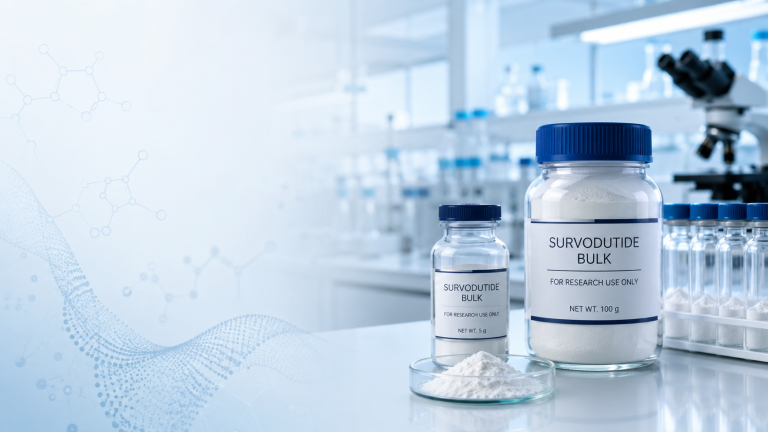

Introduction to Survodutide Raw Material
Survodutide is a synthetic peptide currently under investigation for its interaction with glucagon and GLP-1 receptors. As a raw material, it is supplied in lyophilized powder form intended for reconstitution in controlled research settings. This product is designed exclusively for laboratory research and is not suitable for clinical or veterinary applications. Researchers seeking survodutide raw material for sale require a compound that meets rigorous analytical specifications for in vitro and in vivo studies of dual receptor agonism.
The peptide is manufactured under strictly controlled conditions to ensure batch-to-batch consistency, allowing laboratories to investigate metabolic signaling pathways with reproducible results. All handling and usage must align with institutional guidelines for research-only substances.
Chemical Identity and Class
Survodutide is classified as a dual glucagon/GLP-1 receptor agonist peptide. Its molecular design incorporates an optimized amino acid sequence that facilitates simultaneous binding and activation of the two target receptors, making it a valuable tool for investigating cooperative signaling mechanisms. The compound belongs to a class of long-acting peptides engineered for extended stability in proteolytic environments, which is advantageous for both in vitro assays and animal model experiments.
Each batch is characterized by a unique CAS number and a defined molecular weight, both of which are documented on the certificate of analysis. While the complete structural formula is proprietary, researchers can request detailed analytical data to verify identity and purity. The peptide’s receptor selectivity has been confirmed in binding assays, supporting its use in comparative studies with related mono-agonist or other dual-agonist peptides.
Chemical Properties and Structural Data
The purity of survodutide raw material is routinely verified by high-performance liquid chromatography (HPLC) and mass spectrometry (MS), with acceptance criteria typically set at ≥98%. This high level of purity is essential for minimizing off-target effects in sensitive biochemical experiments. The product appears as a white to off-white lyophilized powder with a shelf life that is established through long-term stability studies under recommended storage conditions.
Solubility profiles and suggested reconstitution buffers are provided in the technical datasheet accompanying each order. Commonly used aqueous solutions, such as sterile phosphate-buffered saline or slightly acidic buffers, can dissolve the peptide effectively for downstream applications. End-users should consult the product documentation for the exact peptide content per vial, as net peptide weight may differ from the total mass due to residual water or counterions. Peptide sequence modifications, such as fatty acid conjugation for extended half-life, are also detailed where applicable, aiding in structural characterization.
Research Applications in Laboratory Settings
Survodutide raw material enables a wide range of research applications. In vitro studies frequently use the peptide to investigate receptor activation kinetics, intracellular signaling cascades, and second-messenger production. Cell lines expressing recombinant GLP-1 and glucagon receptors are employed to measure cyclic adenosine monophosphate (cAMP) accumulation, β-arrestin recruitment, and receptor internalization. These assays help delineate the balance between acute signaling and receptor desensitization.
In animal model research, survodutide is administered to explore metabolic and endocrine mechanisms. Preclinical studies in rodent and non-human primate models focus on parameters such as body weight, food intake, insulin secretion, and energy expenditure – all within an exploratory context that does not infer clinical benefit. Such experiments contribute to a mechanistic understanding of dual receptor agonism on systemic metabolism. Additionally, structure-activity relationship (SAR) studies utilize survodutide as a reference compound for developing novel peptide analogs with altered selectivity or pharmacodynamic profiles.
Mechanism of Action Studies
One of the primary utilities of survodutide in the laboratory is the investigation of dual receptor agonism at the cellular level. Researchers measure changes in intracellular cAMP levels upon peptide exposure, distinguishing downstream effects mediated through each receptor subtype. Co-stimulation of GLP-1 and glucagon receptors can produce synergistic or divergent responses, depending on the tissue context, and survodutide provides a tool to dissect these pathways.
Supporting research into insulin secretion and energy homeostasis, survodutide is applied in pancreatic islet assays and hepatocyte cultures to evaluate glucagon-like peptide-1 (GLP-1)-mediated insulin release and glucagon-driven glucose output. In vivo, regulated dosing schedules in healthy or disease-model animals allow assessment of metabolic adaptation without implying any therapeutic use. The peptide also facilitates studies on biased signaling, where a receptor can preferentially activate certain intracellular messengers over others. By comparing survodutide with other GLP-1 or glucagon receptor agonists, scientists characterize how ligand structure influences signaling bias and receptor desensitization patterns.
Quality Specifications and Analytical Testing
Every batch of survodutide raw material undergoes a comprehensive analytical panel. High-performance liquid chromatography (HPLC) and liquid chromatography-mass spectrometry (LC-MS) confirm both purity and molecular mass, with a typical acceptance threshold of ≥98% purity. Amino acid analysis is performed to verify the peptide’s composition and sequence integrity. Additional tests, such as infrared spectroscopy, may be included depending on synthetic methodology.
Endotoxin levels are stringently controlled to meet research-grade standards, typically below 1.0 EU/mg, ensuring suitability for cell-based experiments. A certificate of analysis (CoA) accompanies each shipment, summarizing the batch-specific results for purity, mass, peptide content, and residual solvents. This document serves as a vital reference for maintaining experimental reproducibility and fulfills documentation requirements for peer-reviewed publications.
Storage and Handling Recommendations
To preserve structural integrity, lyophilized survodutide should be stored at -20°C or below, protected from moisture and direct light. Under these conditions, the peptide remains stable for the shelf life indicated on the product label. Before reconstitution, vials should be equilibrated to room temperature to prevent condensation.
After dissolution, solutions should be used promptly and stored at 2–8°C for short-term experiments (typically no more than 48 hours). For extended use, aliquoting and freezing at -20°C to -80°C is recommended, though repeated freeze-thaw cycles must be avoided as they can induce aggregation or degradation. The choice of diluent, such as sterile water for injection (WFI) or buffer containing 0.1% bovine serum albumin, can influence stability; therefore, researchers should consult the product-specific handling guide.
Ordering Information and Distribution
Survodutide raw material is available in multiple pack sizes to accommodate different research scales, from milligram quantities for initial screening to gram-level orders for larger preclinical studies. Orders are processed with lead times that depend on current inventory levels and capacity for custom synthesis. Bulk and custom aliquots can be prepared upon request to reduce the need for in-lab subdivision.
Shipping is performed under controlled temperature conditions, typically using insulated containers with cold packs or dry ice, to maintain product stability during transit. All shipments include temperature monitoring where necessary. End-users are notified of the dispatch date and provided tracking information. For researchers sourcing survodutide raw material for sale, it is advisable to confirm the supplier’s quality management system and willingness to share detailed analytical data before purchase.
Compliance and Regulatory Status
This product is provided exclusively for laboratory research purposes. It is not intended for human or veterinary use, nor for any diagnostic or clinical application. Purchasers must ensure that their use complies with all applicable local, national, and international regulations governing research chemicals. Survodutide is not classified as a pharmaceutical ingredient and may not be resold for any non-research purpose.
Each shipment is accompanied by documentation that outlines the research-only status, safety data, and handling precautions. Institutional review bodies may require additional information for protocol approval, and the supplier typically supplies material transfer agreements upon request. By adhering to these compliance measures, the research community can responsibly advance knowledge of dual receptor pharmacology without misuse.
Research use only. This information is provided solely for educational and informational purposes to support laboratory research. Survodutide raw material is not for use in humans or animals intended for food production. Any references to physiological or metabolic outcomes are strictly within a preclinical research context and do not imply any therapeutic or diagnostic application.
For research use only. Not for human or veterinary use.