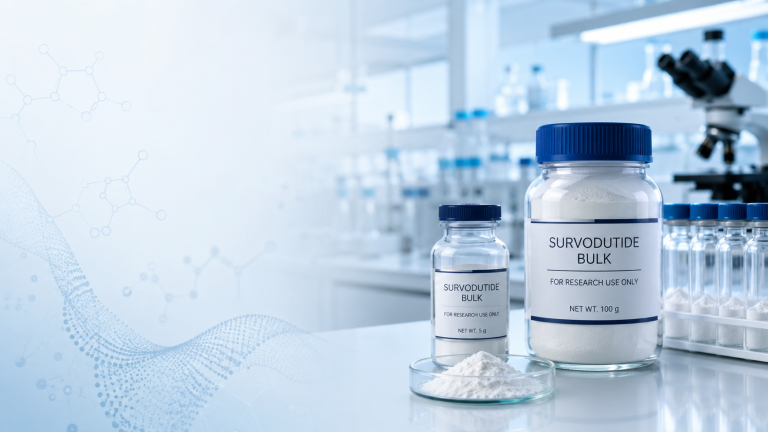

Overview of Survodutide in Research
Survodutide is a synthetic peptide engineered to act as a dual agonist at the glucagon-like peptide-1 (GLP-1) receptor and the glucagon receptor. This dual-target mechanism has drawn attention in metabolic research for its potential to influence energy balance, nutrient metabolism, and body weight regulation in experimental models. The peptide is characterized by a defined amino acid sequence that has been optimized for balanced receptor activation, enabling researchers to probe the crosstalk between incretin and glucagon signaling pathways.
At the molecular level, Survodutide exhibits a high degree of stability in its lyophilized form and is typically supplied as a trifluoroacetate salt. Its primary structure can be confirmed via mass spectrometry, and secondary structure predictions suggest a helical conformation favorable for receptor binding. Research groups commonly utilize Survodutide in ligand-binding assays to calculate binding affinities (IC50/EC50) across species-specific receptors, as well as in functional assays that measure cyclic adenosine monophosphate (cAMP) accumulation or β-arrestin recruitment.
Preclinical investigations employ Survodutide in a range of in vitro and in vivo models. In vitro, the peptide is applied to cell lines expressing recombinant GLP-1 or glucagon receptors to assess signal transduction kinetics and receptor desensitization patterns. In vivo, rodent and non-human primate models are used to study its impact on food intake, gastric emptying, and hepatic glucose output. Observations from these models contribute to the broader understanding of neuroendocrine circuits governing energy homeostasis, without implying any therapeutic outcome. Reputable suppliers provide Survodutide that has been validated in such models, ensuring that batches meet the purity and activity specifications required for reproducible experimentation.
Criteria for Selecting a Research Grade Supplier
Obtaining Survodutide from a qualified research grade supplier is critical for experimental integrity. Several pillars distinguish a dependable source, including rigorous analytical characterization, transparent documentation, and logistical capabilities that preserve peptide stability.
Quality Assurance and Purity Standards
High-performance liquid chromatography (HPLC) stands as the primary method for assessing peptide purity. A research grade supplier will routinely report purity ≥98% as determined by reverse-phase HPLC with ultraviolet detection at 214 nm, where the peptide bond absorbs strongly. Impurity profiles are disclosed, with individual related substances typically below 0.5%. Mass spectrometry (MS), often electrospray ionization time-of-flight (ESI-TOF) or matrix-assisted laser desorption/ionization (MALDI), corroborates the molecular weight and sequence integrity, confirming that the observed mass matches the theoretical mass within acceptable mass error (usually <50 ppm).
Batch-to-batch consistency is documented in a certificate of analysis (COA) that includes net peptide content, counterion content (e.g., acetate or trifluoroacetate), and water content (Karl Fischer titration). Stability data under recommended storage conditions may also be available, indicating the peptide’s robustness over multiple freeze-thaw cycles. These metrics assure researchers that the peptide will perform predictably across experiments, minimizing inter-assay variability.
Documentation and Regulatory Compliance
A credible supplier provides a comprehensive documentation package: the COA, a material safety data sheet (MSDS) or safety data sheet (SDS), and, upon request, structural characterization data (HPLC chromatogram, MS spectrum). Every vial or container label must explicitly state “For Research Use Only. Not for Diagnostic or Pharmaceutical Purposes.” This labeling is a non-negotiable indicator of compliance with international research standards and customs requirements.
For shipments crossing borders, the supplier can supply export certificates, such as a Certificate of Origin or an invoice declaration for customs valuation. Items destined for academic or industrial research laboratories are classified under appropriate Harmonized System (HS) codes for peptides (e.g., 2933 or 3504), and the accompanying paperwork unequivocally states the material’s non-hazardous, non-clinical nature. Such diligence prevents delays and ensures that institutional biosafety and import permits are respected.
Supply Chain and Logistics
Survodutide, whether supplied as a lyophilized powder or in a custom reconstituted formulation, requires cold chain management to maintain activity. Research grade suppliers typically ship with validated temperature-controlled packaging, using dry ice or phase-change materials and real-time temperature loggers upon request. Delivery times from order confirmation average 2–4 weeks, depending on batch availability and destination. Expedited options are often available for time-sensitive studies.
Ordering flexibility is another hallmark. Suppliers commonly accommodate minimum order quantities from as little as 1 mg for pilot studies to gram-scale for long-term projects, with volume-based pricing structures. Researchers can also engage in contractual agreements for scheduled deliveries, ensuring continuity in multi-year programs. Such adaptive supply chains are essential for laboratories scaling from early discovery to advanced preclinical evaluation.
Verifying Supplier Credentials
Beyond marketing claims, objective evidence of a supplier’s reliability can be gathered through certifications, third-party validation, and publication records. ISO 9001 certification signals that the supplier operates under a documented quality management system, with regular audits covering design, procurement, production, and distribution. Some suppliers also pursue ISO 13485 or relevant Good Manufacturing Practice (GMP) certifications for research-grade peptides, even when the product is not intended for clinical use, which speaks to disciplined process control.
Peer-reviewed publications represent another powerful verification tool. Many journals require that authors disclose the source and catalog number of key reagents. Tracking citations where Survodutide was used—especially those reporting binding affinities, in vivo metabolic outcomes, or pharmacokinetic profiles—can give confidence in a supplier’s product. While the absence of citations does not inherently discredit a supplier, the presence of consistent data across independent groups is reassuring.
Independent third-party testing further reduces risk. Some laboratories send aliquots of purchased peptides to accredited analytical service providers for orthogonal purity checks using ultra-performance liquid chromatography (UPLC) or amino acid analysis. Such independent data, often shared within consortia, corroborate supplier COAs and can unmask discrepancies in net peptide content or aggregation. When a supplier routinely matches or exceeds specifications in external audits, it builds a reputation for deliverable quality.
Handling and Storage Recommendations
Optimal handling begins upon receipt. Lyophilized Survodutide should be stored desiccated at -20°C or lower, ideally in a non-frost-free freezer to minimize temperature fluctuations. When stored properly, the shelf life typically ranges from 12 to 24 months from the date of manufacture; the exact expiry date will be listed on the product COA. Brief excursions to ambient temperature during weighing are tolerated, but prolonged exposure to warmth and humidity accelerates degradation through oxidation and deamidation.
For reconstitution, use a suitable buffer such as phosphate-buffered saline (PBS) at pH 7.4, or another sterile, inert diluent recommended in the supplier’s handling notes. Gentle swirling—never vortexing—helps dissolve the peptide while preserving structural integrity. Aliquots of the reconstituted solution should be stored at -80°C and thawed once immediately before use; repeated freeze-thaw cycles promote aggregation and loss of bioactivity. Filtration through a low-protein-binding 0.22 µm membrane can remove any microparticulates before cell-based or animal experiments.
Frequently Asked Questions
What purity levels are standard?
Research grade Survodutide is typically supplied at ≥95% purity by HPLC, though suppliers targeting high-performance applications often guarantee ≥98%. The purity threshold should match the intended assay: competitive binding assays may tolerate 95% purity, whereas sensitive cell-based functional assays and in vivo studies benefit from the higher grade to reduce interference from impurities.
Are there shipping restrictions?
Survodutide is not classified as a dangerous good under IATA, DOT, or IMDG transport regulations when shipped in non-infectious, lyophilized form. Standard cold-chain shipping with dry ice is permissible internationally for research orders, provided the consignee has no import restrictions on synthetic peptides. Some countries require an import permit or an end-user declaration confirming the material’s research-only purpose; a proactive supplier will guide customers through this documentation.
Can we order bulk quantities?
Most research grade suppliers offer bulk ordering options. Quantities can range from milligrams to multiple grams, with volume discounts common for academic and industry research contracts exceeding defined thresholds. For very large campaigns, custom synthesis and dedicated batch reservations are negotiable, along with extended stability studies tailored to the researcher’s storage conditions.
Note: All products, including Survodutide, are provided strictly for laboratory research use only. They are not intended for any diagnostic, therapeutic, or in-human applications. Statements herein are based on published peer-reviewed data and supplier documentation and do not imply any clinical benefit or approved use outside of a controlled research environment.
For research use only. Not for human or veterinary use.