Introducción a la ipamorelina como péptido de investigación
Ipamorelin is a synthetic pentapeptide (Aib-His-D-2-Nal-D-Phe-Lys-NH₂) classified as a growth hormone secretagogue. Its sequence is designed to selectively bind and activate the ghrelin receptor (GHS-R1a), triggering intracellular signaling cascades that researchers study in the context of protein synthesis, cellular regeneration, and metabolic pathway analysis. Unlike some earlier peptides in its class, Ipamorelin demonstrates a more targeted receptor activation profile, which makes it a useful tool for investigating distinct downstream effects without off-target interference.
In laboratory settings, Ipamorelin is employed to examine how GHS-R1a stimulation influences calcium mobilization, cAMP modulation, and MAP kinase pathways. These investigations provide insight into cell proliferation, tissue remodeling, and energy homeostasis at the molecular level. Because the peptide is for exclusive research use—never intended for human or veterinary applications—all handling occurs within controlled in vitro environments, often using cell lines or animal tissue samples in compliance with institutional biosafety protocols. As interest in ghrelin receptor biology expands, so does the demand for Ipamorelin in quantities that support large-scale or longitudinal studies, making bulk purchase options a practical consideration for labs and distribution partners.
Benefits of Bulk Orders for Research Institutions
When a research program requires consistent and substantial amounts of Ipamorelin, moving from small aliquot purchases to a bulk order offers several operational advantages. The following benefits are particularly relevant for academic institutions, pharmaceutical R&D groups, and authorized distributors managing multi-site studies.
- Cost efficiency through volume pricing: Most peptide suppliers apply a tiered pricing model where the cost per gram decreases significantly once a minimum quantity threshold is met. For a laboratory consuming 500 mg per month, an annual 5-gram order can reduce the per-experiment expenditure by 25–40% compared to monthly 500 mg purchases, freeing budget for ancillary reagents.
- Consistent lot-to-lot quality: Receiving a single, large batch ensures that all experiments within a study series use material from the same synthesis run. This homogeneity eliminates the analytical variables that can arise from minor inter-batch differences in purity, peptide counter-ion content, or residual solvent profiles—factors critical when generating reproducible data in quantitative assays such as EC50 determinations or receptor binding studies.
- Reduced lead times and simplified logistics: With a bulk order, researchers avoid the risk of stockouts during critical experimental windows. A single shipment, cleared through customs once, replaces many smaller consignments, streamlining inventory management and reducing shipping documentation overhead. This is especially valuable for large-scale studies involving multiple research teams or internationally coordinated projects.
These benefits directly support the rigorous demands of preclinical research, where reproducibility, cost control, and uninterrupted supply are foundational.
Minimum Quantity Requirements for Ipamorelin Bulk Orders
El Ipamorelin bulk order minimum quantity is a starting point defined by the peptide supplier and reflects economic batch sizing, production capacity, and commercial policy. For standard research-grade Ipamorelin, typical minimum order quantities range from 1 gram to 5 grams. The exact figure depends on the supplier’s manufacturing setup and the product form offered. Some manufacturers list a 1-gram minimum for their catalog-grade (>98% purity) product, while others set the entry point at 5 grams to justify the cost of lyophilization and quality-control analysis across multiple vials.
Purity specification further influences the minimum order. Ipamorelin with a certified purity above 99% (often prepared by additional HPLC polishing steps) may carry a higher minimum quantity—commonly 2 to 5 grams—because the extra processing steps reduce overall yield and require larger starting amounts to remain economically viable. Conversely, a batch certified at >95% might be available with a lower threshold, though most professional laboratories prefer >98% purity to minimize interference from peptide-related impurities in sensitive assays.
Custom synthesis projects, where the client requests a particular salt form, specific net peptide content target, or a non-standard package configuration, almost always involve higher minimums. For instance, a custom order requiring a specific acetate content verified by ion chromatography might only be feasible at a 10-gram scale due to the analytical method development and dedicated production slot. Laboratories seeking to incorporate a stable isotope-labeled variant or a fluorescent conjugate for imaging studies should anticipate even larger minimum quantities, driven by the complexity and cost of the modified synthesization.
Factors Influencing Minimum Order Quantities
Several operational and regulatory factors shape the minimum order thresholds that suppliers set for Ipamorelin. Understanding these can help research buyers negotiate or plan around the requirements.
- Production scale and peptide complexity: Ipamorelin, as a pentapeptide, is assembled via solid-phase peptide synthesis (SPPS). The scale of the reactor and the yield after cleavage and purification determine the feasible batch size. While a 10-gram batch may be routine, smaller custom runs (e.g., 500 mg) can be disproportionate in labor and solvent costs, leading suppliers to protect margins through higher minimums. The presence of the α-aminoisobutyric acid (Aib) residue, which can couple with lower efficiency, further influences batch economics.
- Regulatory constraints for research-use-only peptides: Ipamorelin is classified exclusively as a research chemical. Suppliers must maintain rigorous documentation showing that all shipments are for legitimate laboratory purposes. For bulk exports, additional customs paperwork, end-user declarations, and sometimes import permits are required. The administrative load of handling a 10-kg order is similar to a 500-g order, so suppliers often set a minimum to cover these fixed transaction costs.
- Supplier inventory and demand forecasting: A supplier that holds Ipamorelin in stock may allow relatively low bulk minimums (e.g., 2 grams) to serve smaller research groups. However, if the product is made to order against a volatile demand pattern, the supplier will likely enforce a higher minimum to ensure production runs are economically scheduled. Seasonal university purchasing cycles or large single-client tenders can temporarily lower or raise what is considered a standard bulk order minimum quantity.
How to Place a Bulk Order for Ipamorelin
Moving from initial inquiry to confirmed shipment involves a sequence of compliance and commercial steps. The following approach helps ensure a smooth procurement process while meeting all regulatory obligations for a research-use-only peptide.
- Contact the supplier’s sales team with precise specifications: Provide the desired total quantity, preferred purity grade (e.g., >98% or >99%), and any special request such as net peptide content determination or endotoxin testing levels. If the order is for multiple laboratories, clarify whether you require bulk powder in a single container or pre-aliquoted into smaller vials to minimize in-house handling.
- Provide a brief description of the intended research application for compliance: Because Ipamorelin is subject to research-use-only controls, a short statement such as “investigation of GHS-R1a signaling in cultured hepatocytes” or “metabolic pathway analysis in murine tissue models” is typically required. This information is used solely for internal compliance screening and does not imply any endorsement of human or veterinary use.
- Agree on lead time, payment terms, and shipping conditions: Bulk orders often involve a non-standard delivery schedule. Confirm whether the batch will be lyophilized fresh for the order (adding 1–2 weeks) or drawn from existing stock. Payment methods such as wire transfer or letter of credit may apply for large amounts. Define the Incoterms, shipping carrier, and any temperature-controlled packaging needs before issuing a purchase order.
- Finalize documentation: For international transactions, the supplier will prepare a proforma invoice, a Certificate of Analysis (CoA) template, and often an End-User Statement. Review these carefully to ensure the customs tariff code reflects a research-only peptide for a smooth import clearance.
Quality Assurance in Ipamorelin Bulk Supply
In bulk peptide procurement, quality assurance is not a single test but an integrated system that verifies identity, purity, and safety for the intended in vitro application. Reputable manufacturers implement a battery of analytical techniques for every batch of Ipamorelin released, regardless of size.
- Cromatografía líquida de alta resolución (HPLC): The primary purity assay, typically performed using a reverse-phase C18 column with a water/acetonitrile gradient, quantifies the peak area of Ipamorelin relative to all detectable components. A specification of ≥98% purity by HPLC at 220 nm is standard for research-grade peptide. The CoA will include the exact purity percentage and the retention time.
- Espectrometría de masas (MS): Electrospray ionization (ESI) or matrix-assisted laser desorption ionization (MALDI) mass spectrometry confirms the molecular weight matches the theoretical monoisotopic mass of Ipamorelin (approximately 711.4 Da for the free base). A high-resolution MS spectrum showing the [M+H]⁺ and [M+2H]²⁺ ions within 0.5 Da of the expected values provides confidence in structural integrity.
- Endotoxin testing: For cell-based in vitro research, endotoxin contamination can confound results. Bulk Ipamorelin batches are tested using the Limulus Amebocyte Lysate (LAL) method per United States Pharmacopeia (USP) chapter <85> guidelines. A typical acceptance criterion is ≤1.0 EU/mg, ensuring compatibility with sensitive primary cell cultures or immune cell assays.
- Additional analyses: Some suppliers include counter-ion content analysis (e.g., acetate or trifluoroacetate quantification by ion chromatography) and residual solvent testing by gas chromatography, especially when the peptide is delivered as a trifluoroacetate salt or when lyophilization parameters could affect long-term stability.
Each bulk shipment should be accompanied by a batch-specific CoA detailing these results, and the batch number should be traceable through the supplier’s quality management system.
Packaging and Shipping of Bulk Peptides
The physical form and transport conditions are critical for maintaining Ipamorelin’s integrity from the manufacturing site to the end-user laboratory. Standard practice involves lyophilization (freeze-drying) to produce a dry, amorphous powder that is stable under proper storage.
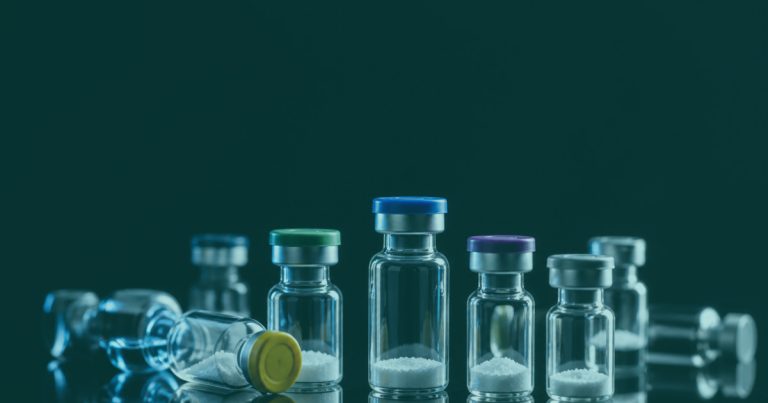
Ipamorelin bulk powder is typically filled aseptically into pharmaceutical-grade glass serum vials sealed with bromobutyl rubber stoppers and aluminum crimp caps. For a 5-gram order, the supplier might deliver one 10 mL vial containing the entire quantity or, if pre-aliquoting is requested, twenty 250 mg vials. The vials are flushed with dry nitrogen or argon during sealing to displace oxygen and protect against oxidation of the peptide’s methionine residue (Ipamorelin contains a lysine rather than methionine, but general peptide stability benefits from inert gas overlay).
During transit, lyophilized Ipamorelin is considered stable at ambient temperature for short periods (1–2 weeks), but many suppliers ship with cool packs or in temperature-controlled containers as a precaution, especially for destinations with extreme climates. For large international consignments, dedicated refrigerated freight or insulated packaging with validated data loggers may be used. The outer shipping box contains a packing list, the CoA, and a customs declaration that explicitly describes the product as “Research peptide – Ipamorelin – Not for human use – No commercial value” to align with customs and trade regulations. Buyers are advised to reconstitute and aliquot the powder upon receipt and store it at -20°C or colder, protected from light, to minimize degradation during long-term study use.
Frequently Asked Questions about Ipamorelin Bulk Orders
What are the typical lead times for an Ipamorelin bulk order?
For stock quantities up to 5 grams, lead times generally range from 1 to 2 weeks, covering final QC release and export documentation. If the order exceeds current inventory or requires a custom synthesis run, the lead time may extend to 3–4 weeks, depending on the solid-phase synthesis cycle, purification scheduling, and lyophilization capacity. Complex modifications, such as stable-label incorporation, can require 5–6 weeks. Always confirm the estimated shipment date with the supplier before committing to an experimental timeline.
Can I order a quantity below the stated minimum?
Many suppliers maintain flexibility for established institutional clients or pilot studies. A request for 500 mg when the listed minimum is 1 gram may be accommodated, particularly if the client has a history of regular purchases or if the order can be combined with another incoming batch. The price per unit, however, will typically be higher than the bulk-tier rate. Smaller amounts—100–200 mg—are usually served through catalog aliquots rather than a formal bulk order.
How does international shipping comply with customs and trade regulations?
All exports are conducted in full observance of the applicable country-of-origin and destination regulations. The peptide is declared under a research-only tariff code, and the supplier provides a Material Safety Data Sheet (MSDS) and commercial invoice detailing the substance’s nature. For certain jurisdictions, an import permit or a notarized End-User Certificate may be required in advance. It is the buyer’s responsibility to verify local import requirements, though experienced suppliers can often assist with documentation to expedite clearance.
Is the bulk powder stable during extended storage?
Lyophilized Ipamorelin, stored in sealed vials at -20°C and protected from moisture and light, typically remains stable for at least two years. After reconstitution in a sterile, aqueous solvent, peptide solutions should be aliquoted into single-use portions and stored at -80°C to maintain integrity, with repeated freeze-thaw cycles avoided. Stability studies should be planned by the researcher according to the specific assay conditions.
All products mentioned, including Ipamorelin, are intended strictly for in vitro laboratory research purposes. They are not for human or veterinary use. Statements in this article have not been evaluated by any regulatory body such as the FDA or EMA. Compliance with local laws and regulations regarding the import and use of research chemicals is the sole responsibility of the buyer. No therapeutic or medical claims are made or implied.
Solo para uso en investigación. No apto para uso humano ni veterinario.